

Understanding the Professionals Behind Blind Rehabilitation: The Role of a CVRT
Blind rehabilitation is a specialized field, but many people do not realize how many different professionals may be involved in helping someone adjust to vision loss. This series will look at those professions individually, including what they do, how they are trained, and how professional qualifications are regulated. To explore each of the certifications for blind and low vision services, visit the Vision Professionals page on the Association for Education & Rehabilitation of the Blind & Visually Impaired (AER) website.
We begin with the Certified Vision Rehabilitation Therapist, commonly known as a CVRT.
What Is a Certified Vision Rehabilitation Therapist?
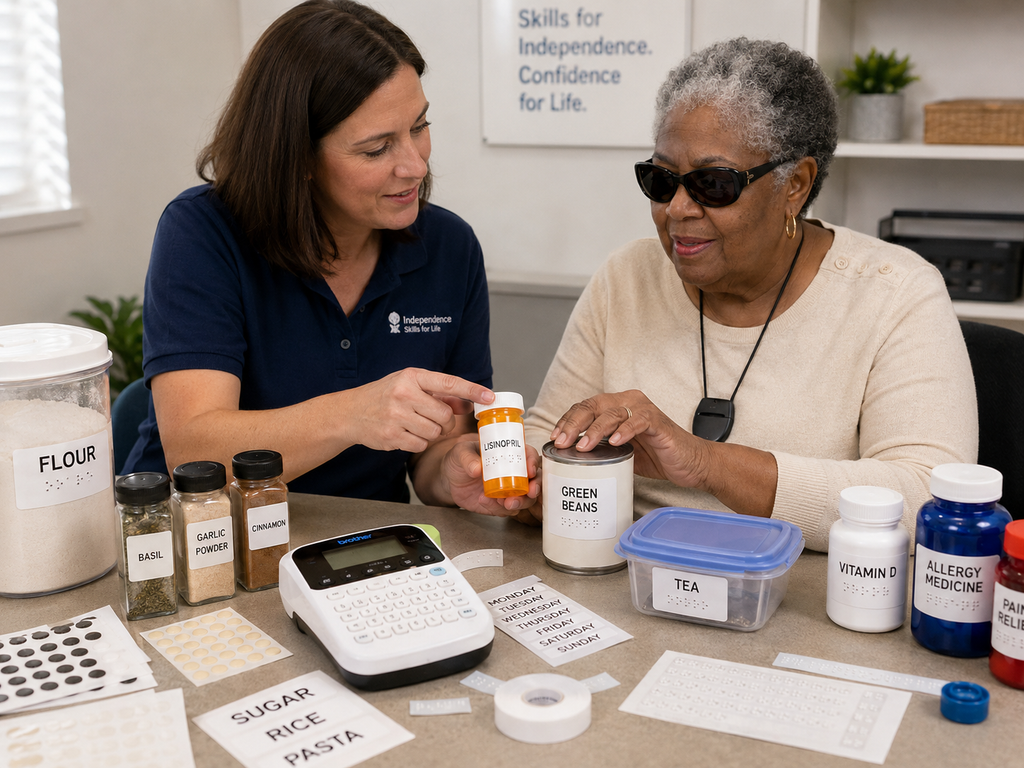
A Certified Vision Rehabilitation Therapist works with people who are blind or have low vision to develop practical skills for everyday life, education, employment, and community participation. The goal is not to teach every person with vision loss the same set of techniques. Vision rehabilitation is individualized. Someone who has lived with blindness for many years may already have highly effective ways to complete daily activities, while someone who recently experienced significant vision loss may need to relearn tasks that previously depended heavily on sight. CVRTs may provide instruction in areas such as meal preparation, home management, personal organization, braille, assistive technology, self-advocacy, adaptive communication, personal care, and basic indoor orientation. The services depend on what the individual needs to accomplish at home, at work, at school, or in the community. A CVRT might work with someone who wants to return to cooking after losing vision. Training could include tactile measuring techniques, safe knife skills, appliance marking, ingredient organization, labeling systems, and safe liquid-pouring techniques. The objective is not for the instructor to perform the activity for the person. The goal is to develop a method the individual can use independently after formal training ends.
Technology can also be an important part of vision rehabilitation. Depending on the person’s needs and the CVRT’s training, this may include learning how to use screen readers, screen magnification, electronic or optical magnifiers, braille, and other adaptive tools. The goal is not simply to introduce someone to a piece of technology, but to help them use it in ways that support everyday activities, education, employment, and independence.
The Academy for Certification of Vision Rehabilitation & Education Professionals, or ACVREP, includes a wide range of skills within the CVRT scope of practice. These can include assessment, individualized rehabilitation planning, independent living skills, adaptive communication, braille, assistive technology, and basic indoor orientation and mobility. Some training also falls outside the CVRT’s primary role. A CVRT may help someone learn basic orientation and safety skills for moving around familiar indoor spaces. An Orientation and Mobility professional generally teaches more advanced travel skills, such as using a white cane, crossing streets, using public transportation, or traveling independently in the community. Having professionals with different areas of expertise helps people receive the type of instruction that best fits their individual needs and goals.

What Education Is Required to Become a CVRT?
Becoming a CVRT involves considerably more than learning a collection of blindness techniques. Under ACVREP’s current Category 1 pathway for U.S. candidates, an applicant must have at least a bachelor’s degree from an accredited college or university with an emphasis in Vision Rehabilitation Therapy. Candidates must also complete at least 350 hours of discipline-specific supervised practice. At least 260 of those hours must involve direct services to consumers or family members, and a current CVRT must supervise the internship. Candidates must then pass the ACVREP certification examination. The certification itself also represents an ongoing professional commitment. ACVREP currently charges $140 to apply for eligibility, $490 to take the certification exam, and $125 for the initial certification. Once earned, the CVRT credential is valid for five years before the professional must complete the recertification process. These steps are meant to show that a CVRT has developed knowledge and skills across the full range of vision rehabilitation services, rather than being trained in only one specific area.
How Much Can a CVRT Earn?
What a CVRT earns can vary widely depending on where they work. A position with the Department of Veterans Affairs may pay very differently from a state Vocational Rehabilitation job or a nonprofit rehabilitation agency. Location, experience, education, additional certifications, and whether the position includes supervisory or technology responsibilities can also affect pay.
In the Department of Veterans Affairs, CVRTs may work under the broader title of Blind Rehabilitation Specialist rather than simply Vision Rehabilitation Therapist. Current VA postings show Blind Rehabilitation Specialist positions at the GS-9 through GS-11 levels. For example, a 2026 VA posting in West Palm Beach, Florida listed a salary range of $65,735 to $103,399 per year, while a similar position in Tucson, Arizona listed $62,893 to $98,928. The VA can therefore offer strong earning potential, particularly as a professional move into higher GS levels. Federal employment may also include benefits such as health insurance, retirement programs, paid leave, and scheduled pay increases, so the total compensation package can be worth more than the salary alone.
State Vocational Rehabilitation systems vary much more from one state to another. In Pennsylvania, for example, a 2026 Vision Rehabilitation Therapist position with the Bureau of Blindness and Visual Services listed a salary range of $60,538 to $92,010 per year. Alabama’s Vision Rehabilitation Therapist classification lists a salary range of approximately $39,312 to $65,726 per year. Those examples show why it is difficult to talk about one “VR salary.” State budgets, pay classifications, cost of living, union agreements, education requirements, and years of service can all affect what a rehabilitation professional earns. It is also important not to confuse the rate a VR agency pays for a service with the salary earned by the CVRT providing that service. A government agency may reimburse a provider or contractor $60, $70, or more per service hour, but that money may also have to cover travel, documentation, payroll taxes, benefits, insurance, administrative expenses, equipment, and other business costs. The professional’s actual take-home earnings may be much lower.
Nonprofit organizations show another wide range of salaries. A current Certified Vision Rehabilitation Specialist position with Lighthouse Central Florida lists annual pay of $55,000 to $60,000. A combined Vision Rehabilitation Therapist and Assistive Technology Specialist position with Lighthouse Louisiana lists approximately $55,200 to $60,200. Another Florida nonprofit has advertised CVRT, COMS, or TVI positions in the $60,000 to $70,000 range. Nonprofit salaries can also be considerably higher in higher-cost areas. Lighthouse Guild in New York has advertised a Vision Rehabilitation Therapist position at roughly $90,761 per year. This is a good example of why location matters when comparing salaries.
Across these examples, a CVRT in a nonprofit organization may commonly see salaries in the mid-$50,000s through the $70,000 range, although some organizations pay more. State VR positions may range from roughly $40,000 into the $90,000 range depending on the state and level of experience. Federal VA positions can reach into the upper $90,000s or above $100,000 depending on locality and grade. View these numbers as examples rather than fixed national averages. The CVRT workforce is relatively small, and job titles are not always consistent. One employer may use the title Vision Rehabilitation Therapist, another may use Blind Rehabilitation Specialist, and another may combine VRT duties with assistive technology, low vision, or program-management responsibilities.
For someone considering the profession, salary is only one part of the employment picture. Benefits, retirement, travel expectations, caseload size, opportunities for advancement, continuing-education support, and whether the position requires additional certifications can make two jobs with similar salaries feel very different in practice. The larger issue is that the level of education and specialization required to become a CVRT is not always reflected consistently in pay across employment settings. As the field continues to deal with a shortage of qualified professionals, compensation will likely remain an important part of the conversation about recruitment and retention.
A Field with a Personnel Problem
Blind rehabilitation faces a workforce challenge that has existed for years. More difficult to establish is an exact national number showing how many CVRTs the United States is “short.” There is no single federal workforce database that provides a reliable national shortage figure specifically for CVRTs. However, clear evidence shows that the supply of qualified blindness rehabilitation personnel remains a national concern.
The U.S. Department of Education maintains a Rehabilitation Long-Term Training program specifically intended to support university preparation of rehabilitation professionals. One component is devoted specifically to preparing professionals to provide specialized rehabilitation services to individuals who are blind or have low vision. For fiscal year 2025, the listed grantees in that specialty included Northern Illinois University and the University of Massachusetts Boston. Federal special-education law similarly recognizes visual impairment as a “low-incidence disability,” a category in which relatively small numbers of professionals with highly specialized knowledge are needed. Federal personnel-development programs continue to fund recruitment, preparation, and retention efforts for specialized disability professionals. This creates a difficult cycle. A small profession means fewer university programs. Fewer programs make professional preparation harder to access geographically. That can reduce the number of people entering the profession, particularly when students must relocate or find specialized internship supervision. For agencies serving rural communities, the shortage can be even more noticeable because qualified professionals may cover very large geographic areas.
The Certification Question
This leads to one of the more complicated issues facing blind rehabilitation. A person does not necessarily need CVRT certification to work with people who are blind or have low vision in every setting in the United States. Some employers specifically require ACVREP certification. The Department of Veterans Affairs, for example, has positions in which Blind Rehabilitation Specialists providing communication and daily living therapy must hold CVRT certification, just as specialists providing orientation and mobility, low-vision therapy, or assistive technology may be required to hold the corresponding ACVREP credential. Outside systems with those requirements, however, credential expectations vary considerably by employer, state, funding agency and job description. This distinction is important because “blindness professional” is a broad description. Someone can have substantial professional or lived experience with blindness without being a CVRT, COMS, CLVT, or CATIS.
Being blind and being trained as a rehabilitation professional are two different things. A blind professional may bring years of personal experience, practical problem-solving skills, and a firsthand understanding of what it is like to live and work with vision loss. That experience can be extremely valuable, but it does not automatically mean someone has been trained to assess clients, develop rehabilitation plans, or teach specialized skills.
The same applies to sighted professionals. Simply being sighted does not make someone qualified to teach blindness-related skills. In both cases, the quality of the service should come down to the person’s education, training, experience, and ability to provide the specific type of instruction the client needs. Both lived experience and professional preparation can bring real value to rehabilitation services. In fact, some professionals bring both. What matters most is that the person providing services can demonstrate the knowledge, training, and skills needed for the work.
How Does This Compare with Similar Professions?
This is where blind rehabilitation differs considerably from several related occupations. An occupational therapist cannot simply begin practicing occupational therapy because they have experience helping people perform activities of daily living. Occupational therapy is regulated in all 50 states, the District of Columbia, Puerto Rico and Guam. Practitioners must meet education, fieldwork, examination and state licensure requirements. Physical therapy follows a similar model. Entry into the profession generally requires a Doctor of Physical Therapy degree, and every state requires physical therapists to be licensed. Speech-language pathology is also regulated. Speech-language pathologists typically need at least a master’s degree, supervised clinical experience and an examination, and all states require licensure. Rehabilitation counseling provides an interesting middle ground. A master’s degree is typical, but licensing requirements vary depending on the services being performed. Rehabilitation counselors who provide clinical counseling usually need licensure in the state where they practice. However, professionals who focus mainly on vocational rehabilitation, employment support, or job placement may be able to work without that same level of licensure, depending on the state and the type of services they provide. That difference raises an important question about how professional standards apply across rehabilitation fields. If specialized instruction for a person recovering from a physical disability is considered important enough to regulate through professional licensure, should comparable competency protections exist when a person who has lost vision is learning to cook safely, manage medication, use technology, read braille, navigate environments, or return to employment?

Should Certification Become Mandatory?
Both sides have reasonable arguments. Supporters of stronger national credential requirements can argue that consumers deserve a predictable minimum level of education, supervised practice, ethical accountability, and demonstrated competency regardless of where they live. National standards could also make it easier for government agencies, employers, consumers, and families to understand a professional’s qualifications. Public safety is another component. Blind rehabilitation can involve knives, stoves, medication management, electrical appliances, street travel, technology used in employment, and other activities where poor instruction can have consequences. Stronger standards could also bring the profession closer to the regulatory framework already established for occupational therapy, physical therapy and speech-language pathology.
There is another side to the issue. Requiring one certification everywhere could create new problems if the workforce shortage is not addressed first. In rural areas, for example, services could become even harder to find if experienced professionals without that credential were no longer allowed to provide them. It could also affect people who entered the field through older training pathways and have been doing this work successfully for many years.
Cost and access are part of the problem too. Certification can be expensive, and completing specialized coursework and supervised internships may be difficult when only a limited number of university programs and qualified supervisors are available. Because of that, simply requiring everyone to become certified would not fix the larger issue. Any move toward stronger standards would also need to address education, supervision, cost, and the shortage of professionals entering the field.
What Could Change Across the United States?
A stronger national approach would need to focus on both professional standards and workforce growth. Clear minimum expectations could help make sure people providing specialized blind rehabilitation services have the knowledge and skills needed to do the work well. At the same time, there would need to be more realistic ways for people to enter the field and meet those expectations.
This could include creating more university programs and making distance-learning options easier to access, especially for people who do not live near a program. Paid internships, additional federal and state tuition assistance, and apprenticeship opportunities could also make it easier for more people to enter the field. Other improvements could include increasing the number of qualified supervisors, making credentials easier to transfer between states, and giving experienced professionals a reasonable way to meet new standards without disregarding the training and experience they already have.
There could also be clearer scopes of practice. A rehabilitation technician working under professional supervision does not necessarily need the same credential as the professional conducting assessments, developing the rehabilitation plan and independently providing specialized instruction. Peer mentors and blind professionals with lived experience can also have important roles without those positions being represented as equivalent to a clinical or rehabilitation credential. Creating standards does not have to mean excluding people from the profession. Done carefully, it can create clearer pathways into it.
Why This Conversation Matters
People experiencing vision loss are often learning new skills during one of the most disruptive periods of their lives. They should be able to understand who is providing their rehabilitation, what training that professional has received, what services the person is qualified to provide and what alternatives are available. At the same time, the United States cannot improve access simply by raising credential requirements. Any movement toward stronger professional standards must be accompanied by serious investment in recruiting and preparing the next generation of blindness rehabilitation professionals. That is the larger issue behind the CVRT designation. The letters after someone’s name are not the service. Good rehabilitation is still individualized, practical and built around what the person receiving services wants to accomplish. Professional education and certification provide a structured way to show that the practitioner has been trained to assess those needs and teach those skills safely and effectively. The long-term challenge for blind rehabilitation is therefore not choosing between access and professional standards. It is building a system that can provide both.
This article is part of our series, “Understanding the Professionals Behind Blind Rehabilitation.” Future articles will examine Orientation and Mobility Specialists, Assistive Technology Instructional Specialists, Low Vision Therapists and other professionals who serve people who are blind or have low vision.